

MARKETING INSTYTUCJI NAUKOWYCH I BADAWCZYCH,
eISSN 2353-8414, 2014, Vol. 13, Issue 3
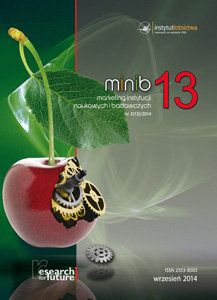
Table of content:
- Putting science on the public agenda
Jezeršek Turnes Jadranka, - Relationship context of personnel marketing of scientific organizations
Baruk Agnieszka Izabela, - Latest trends and directions of development of crowdfunding
Pieniążek Joanna, - New social communication toward the relational capital creation
Jarosławska-Sobór Sylwia, - Universities in social media – Recipients’ expectations and the published contents
Chwiałkowska Agnieszka,
Putting science on the public agenda
Jadranka Jezeršek Turnes, Ph.D.,
Kontekst. Kreativno in poslovno svetovanje, Slovenia
Abstract:
The link between science and society is inevitable and becoming ever more important. Science is a relevant media content, but it needs to provide an interesting story in an attractive field. The question arises of how to get to the story and how to capture the momentum so that the audience or non-experts will understand the advantages, change their behaviour, and create a positive attitude to science.
Being a communication expert, I explored the relationships between society, the media (journalists) and science (scientists). I examined different contexts that are typical of each group and what is the potential to make these relationships work better in order to create acceptable and more broadly engaging science communication.
Relationship context of personnel marketing of scientific organizations
Professor Agnieszka Izabela Baruk, Ph.D.,
Łódź University of Technology, Poland
Abstract:
In the article the problems of relationship context of personnel marketing in scientific organizations were presented. The special attention was paid to feelings of contentment and satisfaction which causing is the main goal of the mentioned idea. The author wanted to realize two research aims (to define the dependences between the level of satisfaction and the level of contentment; to analyse the chosen determinants of the both categories) and to verify the research hypothesis that the level of satisfaction is the significant determinant of the level of contentment. On the base of the results of the field researches one can state that vertical relations are stronger determinants then horizontal relations in the case of the level of satisfaction and in the case of the level of contentment. The strongest dependence exists between the both of analysed categories, so the research hypothesis is true. It shows that organizations must pay the same attention to feelings of satisfaction and contentment by creating the relation system conformable with employees’ expectations and preferences. It can be done thanks implementing personnel marketing.
Latest trends and directions of development of crowdfunding
Joanna Pieniążek, MSc.,
Institute of Aviation, Poland
Abstract:
The article discusses the latest trends and directions of development of crowdfunding on selected examples of English-language websites.The scope of work includes topics such as aggregates of crowdfunding sites, local investing, franchise, pre-sales platforms, open source sites and leveraging the competitive advantages of e-commerce platforms which offer product crowdfunding.
This article aims to discuss the latest trends and directions of crowdfunding, assess their usefulness and the chances of popularising the ideas presented.
The article provides an overview of the literature on the subject and an analysis of the selected sites, comparison sites and crowdfunding search engines.
New social communication toward the relational capital creation
Sylwia Jarosławska-Sobór, M.Sc.,
Central Mining Institute, Poland
Abstract:
Corporate social responsibility is an example of an approach to management that emphasizes the importance of organization’s influence exerted by the company on a number of diverse groups called stakeholders. CSR sets new functions for social communication. In this paper chosen examples of social activities communication of Polish mining companies has been addressed. The main risks for the use of contemporary forms of communication as well as possibilities which are the results of application of modern management model has been indicated.
Universities in social media – Recipients’ expectations and the published contents
Agnieszka Chwiałkowska, M.Sc.,
Nicolaus Copernicus University in Toruń, Poland
Abstract:
Research carried out by the author in 2013, which covered all 59 public universities listed by the Ministry of Science and Higher Education showed that Polish public universities are more and more eagerly resorting to social media as a channel for communication with the environment of students and they are currently active in social media and especially on Facebook, where 81% (48 units) have their official profiles. Also other research projects show that the activities of a university in social media influences the image of the university especially among students – according to them student candidates admit that the presence of universities in social media and information published on their official Facebook profiles and the manner of interaction with users had an impact on their final decision on the choice of a university.
At the same time it is possible to notice a research gap in the area of expectations of main target group for messages of universities published in social media, that is, students, with regard to the form and content of these messages from universities. It is also possible to notice a clear lack of qualitative analyses of activities taken up by Polish universities in social media.
For this reason the author has decided to continue the above-mentioned research in order to learn more about the described phenomenon, that is, the presence of universities on social media platforms. The author has defined the following detailed goals for the research: identification of the expectations of students (who in Poland are the main recipient of universities’ messages in social media) and employees with regard to the presence of the university in social media; identification of student’s preferred methods of communication with the university; Learning about the students’ assessment of the activities of universities conducted in social media; Qualitative analysis of contents published by universities in social media.
The research was conducted in two stages – in the first stage interviews with students, doctoral students, student candidates and university employees were conducted. In the second stage social media profiles – 48 Facebook profiles of Polish universities and top 20 profiles of foreign universities in the ranking of popularity of universities’ activities in social media, according to Top 100 social media colleges and universities 2013 ranking.